
17 September 2021

 Farewell, Caspar Einem (1948-2021)
It is with much sadness that we learned from our Austrian section that Casper Einem, former CEEP/SGI Europe President (2005-2008) and Austrian Minister of Interior (1995-1997), Minister for Science, Traffic and the Arts (1997-2000) as well as Secretary of State (1994-1995), passed away on 9 September at the age of 73. All our thoughts go to his son, and loved ones during this sad time.
Should you wish to express your condolences, please contact SGI Europe Secretariat who will forward the messages.
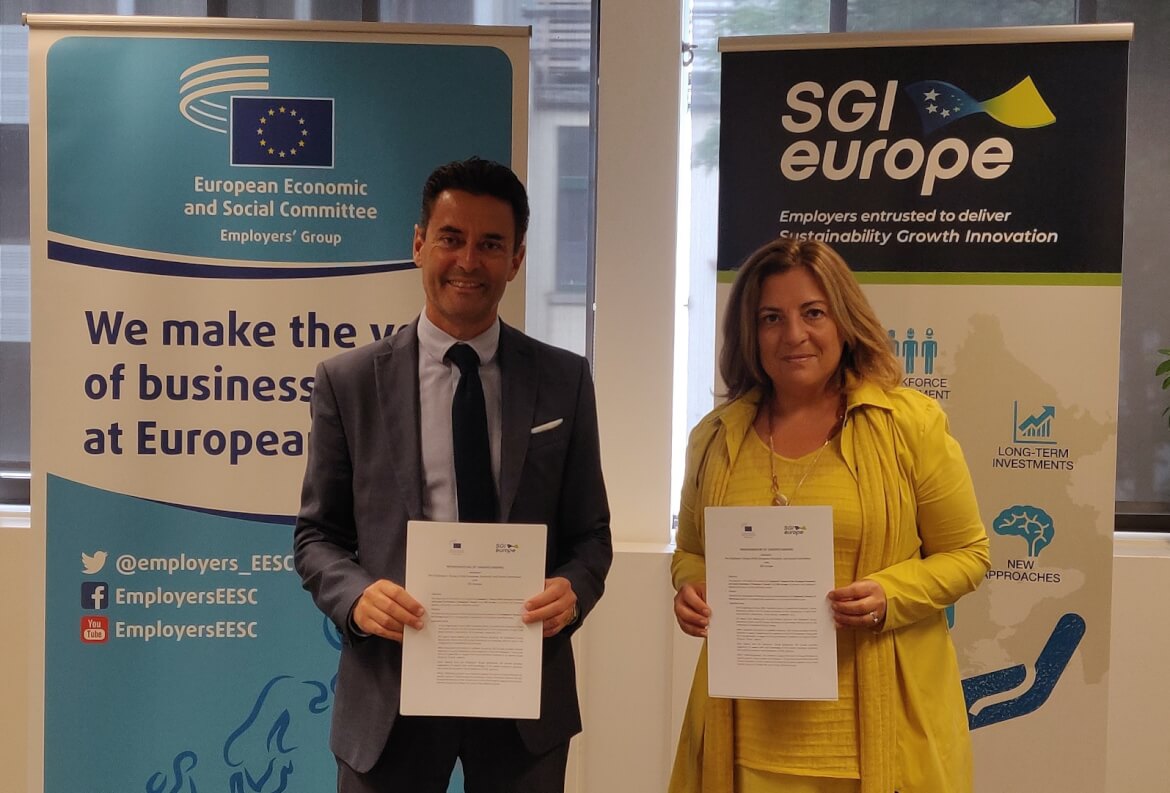
On Tuesday 14 September, SGI Europe and the Employers’ Group of the European Economic and Social Committee signed a Memorandum of Understanding to further enhance cooperation and shape the employers' agenda for a thriving post-COVID-19 EU recovery.
On Wednesday 15 September, Ursula von der Leyen, President of the European Commission, addressed the State of the Union speech to the plenary session of the European Parliament in Strasbourg. Her one-hour-long address focused around two different objectives: defending the success of the EU’s recovery response to the pandemic and the vaccination strategy (internally, but also on the global stage), whilst outlining the upcoming European Commission’s flagship initiatives for the coming year.
Amongst others, President von der Leyen set out the following priorities in the EU’s agenda:
Notably, President von der Leyen mentioned that the EU will relaunch a review of the economic governance in the coming weeks whose aim is ”to build a consensus on the way forward well ahead of 2023”.
Alongside this speech and debate with leaders of the European Parliament, the European Commission published some additional background documents, including President von der Leyen's letter of intent to European Parliament President David Sassoli and Prime Minister Janša, which highlights the main files to be addressed by the European Commission in the upcoming 12 months.
SGI Europe reacted to the speech with the following press release.
Contact: Antonio Astolfi
On 15 September 2021, SGI Europe published its response to the European Commission second stage consultation on a possible action addressing the challenges related to working conditions in platform work. SGI Europe responded to the Commission’s possible avenues of actions regarding the employment status, algorithmic management, the cross-border dimension of platform work and social dialogue. You can find the full response here.
SGI Europe highlighted that the Covid-19 pandemic unveiled the significant role of the platform economy and new forms of work relying on digitalisation, in maintaining an economic activity, even in times of crisis.
Already in its first stage response, SGI Europe and its members expressed that it is crucial that the definition of the status of people that perform work through digital platforms – and whether they are to be seen as employees or self-employed – remains at the national level in the hands of Member States, national social partners, or national courts.”
When it comes to algorithmic management, SGI Europe referred to the importance of the human in control principle in line with the European Social Partners’ Framework Agreement on Digitalisation. According to SGI Europe, the focus should lie on the implementation and the enforcement of the General Data Protection Regulation (GDPR), the regulation on platform-to-business relations (P2B Regulation) and the proposed Artificial Intelligence Act (AI Act) in an efficient and inclusive way, rather than on introducing a new binding instrument.
SGI Europe recognises that platforms are not always employers in the traditional sense. Nevertheless, they can compete with traditional employers and have a competitive advantage because of their legal and organisational nature. A level playing field in the cross-border context is thus necessary as well as providing people working through platforms with accurate information on existing rules and obligations.
SGI Europe already stated in its first stage response that better working conditions for platform work could be achieved through a combination of measures, such as better support and strengthening of collective organisation and bargaining power of people working through platforms. Therefore, one option is to look closer at the interactions between competition policies and the freedom of association. Competition policies should not be a barrier to the freedom of association.
SGI Europe considers that a Council recommendation would be the best tool to address the issues discussed above. A Council recommendation could provide the necessary guidance whilst respecting national traditions and leaving enough margin of manoeuvre to Member States and national social partners.
Any future initiative addressing the working conditions of people working through platforms would address not only employees but also genuine self-employed workers. Therefore, it does not seem appropriate for the EU cross-sectoral social partners to open a negotiation on the issue. However, SGI Europe stands ready to be further involved and contribute to this issue as it is close to Social Partners’ realm of competence.
Contact: Guillaume Afellat
On 16 September, SGI Europe published its position paper on the “Modal Shift towards Rail Freight and Public Passenger Transport” highlighting that increasing the share of public transport and shifting goods from road to rail can significantly bundle the volume of traffic on roads and reduce energy consumption, whilst reducing GHG emissions helping to reach EU’s climate-neutrality targets for 2050.
The transport sector is responsible for around a quarter of greenhouse gas (GHG) emissions in the EU and is therefore one of the largest emitters in Europe. Freight traffic and public passenger traffic by rail and road are already making a significant contribution to climate protection, regardless of the drive technology used.
In fact, transporting goods by road causes around 15 times more CO2 emissions per ton per 2 kilometre than transport by rail. In addition, road transport causes six times higher costs for the general public (“external costs” - land consumption, accident costs, traffic jam costs, air pollution, energy consumption, global warming) than rail transport. By increasing the modal split in passenger and goods’ transport in favour of rail-bound systems, we can achieve an improvement with a leverage effect in favour of all listed factors.
SGI Europe calls for a "modal shift towards rail freight and public passenger transport" and asks the European Commission to set ambitious goals with consistent control measures such as:
You can find our complete position on Modal Shift here.
Contact: Henriette Gleau
On 16 September 2021, SGI Europe responded to the Feedback Consultation on the Roadmap on the Broadband Guidelines. The revision will be based on the results of the Evaluation of State aid rules for deployment of Broadband networks. You can read our contribution here.
SGI Europe welcomes the initiative to revise the current Broadband Guidelines, since with the outbreak of COVID-19, overnight, the entire economy and society had to switch online, the strategic role of the broadband connectivity for all sectors of the economy became undisputable. Furthermore, the role of good connectivity in achieving the creation of jobs, a GDP boost and green transformation should also not be overseen
In achieving these goals, the competition policy should not be seen as a mere enforcer of greater competition but must become a tool for shaping inclusive policies and ensure the Member States have increasing flexibility to design their own policies that correspond to the different national contexts.
Since we welcome the revision and introduction of the new Guidelines, we are at the same time concerned about the timeline envisaged for the adoption, envisaged for the first quarter of 2022. Since the rollout of the broadband networks stands at the crossroads of the major investments that are already being disbursed under the National Recovery and Resilience Plans (NRRPs), we are concerned about the appropriateness of applying slightly outdated rules until the envisaged adoption. In this regard, we call for clear guidance by the Commission.
Contact: Manca Pocivavsek
The SGI Europe CSR Label is the only European label for Services of General Interest (SGIs). With the significant role played by labels in public procurement following the 2014 Directive of the European Parliament and of the Council, the SGI Europe CSR Label has gained in visibility and recognition, bringing to the awarded enterprises a competitive advantage for the public procurement processes.
In this edition the participants will have the chance to certify their developed or ongoing infrastructure projects linked to the economic and social recovery, focusing on their contribution regarding the environmental and digital transitions, social and physical infrastructure, and the overall resilience of essential services.
Announcing the ambitious transition to a new generation of SGI Europe label, this edition will offer its participants a special learning event which will provide them with key knowledge on the ‘EU Taxonomy Regulation’, which will become in the coming years one of the most important instruments at EU level for promoting sustainable investments, including for key SGIs sectors.
The process of the SGI Europe CSR Label will be concluded with a unique Awarding Ceremony, scheduled on 16 February 2022 in Paris (during the French presidency of the Council of the EU). The Ceremony will bring together awarding SGI enterprises and policymakers and engage a conversation on the ‘EU Taxonomy Regulation’, and the role of SGIs in the recovery and the twin transition.
The deadline for applying to the CSR Label is 14 October.
Contact: Stefan Enica
Join us, stay informed
Subscribe to have all the latest news and developments delivered straight to your inbox.